Graphic Bible · Scene 2 of 14
Historical Library · Deuterocanonical Literature
Tobit 2
POB Greek working edition anchored in Swete (1909), retaining its declared local longer-form selection at 6:3–6. Artwork depicts events, reported memories and prayers as this edition presents them.
Source and translation notes
The edition opens with the book of the words of Tobit. The artwork does not authenticate portraits or authorship.
· Greek
Source edition: POB working Tobit edition; Swete 1909 Greek anchor with a declared local Sinaiticus-form selection at 6:3–6. Pinned revision 0aa3e29d92329a4f9420c88f0fcf20ba48e76757.
Chapter and verse numbers follow the available POB edition, including its supplied gaps. Source records are displayed once in their supplied order; missing numbers are not reconstructed.
- Tobit 2:1[a] Or 'the Feast of Weeks.' The Greek says 'Pentecost' and immediately explains it as 'the holy feast of seven weeks.'
- Tobit 2:1[b] The Greek literally says 'I reclined to eat,' reflecting the ancient custom of reclining at table.
- Tobit 2:1[c] The parallel Semitic tradition for this verse is fuller, adding Tobiah's being sent to invite a poor kinsman to the meal; that material is not present in the shorter Greek wording translated here.
- Tobit 2:2[a] Or “many dishes” or “much meat”; the Greek term refers to prepared food served with a meal.
- Tobit 2:2[b] “Our brothers” here means fellow members of Tobit’s people, not only literal siblings.
- Tobit 2:2[c] The closing words are awkward in the Greek manuscript tradition; the sense is that Tobit remains behind waiting for his son to return.
- Tobit 2:3[a] Or “one of our kin.” The Greek says “one from our γένος,” which can refer to family, kin-group, or one’s own people.
- Tobit 2:5[a] The Greek says 'washed myself.' In context this likely refers to washing after corpse impurity; the parallel Semitic tradition makes the purity setting more explicit.
- Tobit 2:5[b] Or 'my meal.' The Greek literally reads 'my bread,' which can also mean food more generally.
- Tobit 2:6[a] The quoted line echoes Amos 8:10 in the Septuagint tradition.
- Tobit 2:7[a] Literally, 'having dug, I buried him.' The object 'a grave' is implied by the burial context and made explicit in English for clarity.
- Tobit 2:8[a] Other textual traditions of Tobit differ substantially here. The indirect Hebrew back-translation has Hannah speaking about Tobit's acts of kindness and righteousness not helping him in his distress and disgrace, rather than neighbors mocking his burial of the dead.
- Tobit 2:9[a] Or 'unclean.' The Greek describes ritual defilement after burial, not necessarily moral impurity.
- Tobit 2:10[a] Or 'small birds'; the Greek στρουθία can refer more generally to small birds, though 'sparrows' is the most likely sense.
- Tobit 2:10[b] The Greek says 'white films' or 'white opacities' formed on his eyes; this is often understood as a cataract-like condition, but the text itself does not give a precise medical diagnosis.
- Tobit 2:11[a] Or 'in women's work'; the Greek phrase may refer generally to work customarily done by women rather than to a physical location.
- Tobit 2:12[a] Or 'masters.' The Greek says 'lords/masters' (κυρίοις), here referring to those for whom she worked.
- Tobit 2:13[a] Greek ἔριφον can also be rendered 'kid,' that is, a young goat.
- Tobit 2:14[a] Or “along with my wages” / “as part of my wages.” The Greek phrase can indicate something given in connection with her pay; the context suggests she claims it was an extra gift rather than stolen property.
- Tobit 2:14[b] Greek “masters” (κυρίοις); here rendered “owners” because the context concerns returning disputed property to those who possessed it.
- Tobit 2:14[c] The Greek literally refers to blushing or reddening; the sense in context is shame or embarrassment.
- Tobit 2:14[d] Or “your almsgivings and your acts of righteousness.”
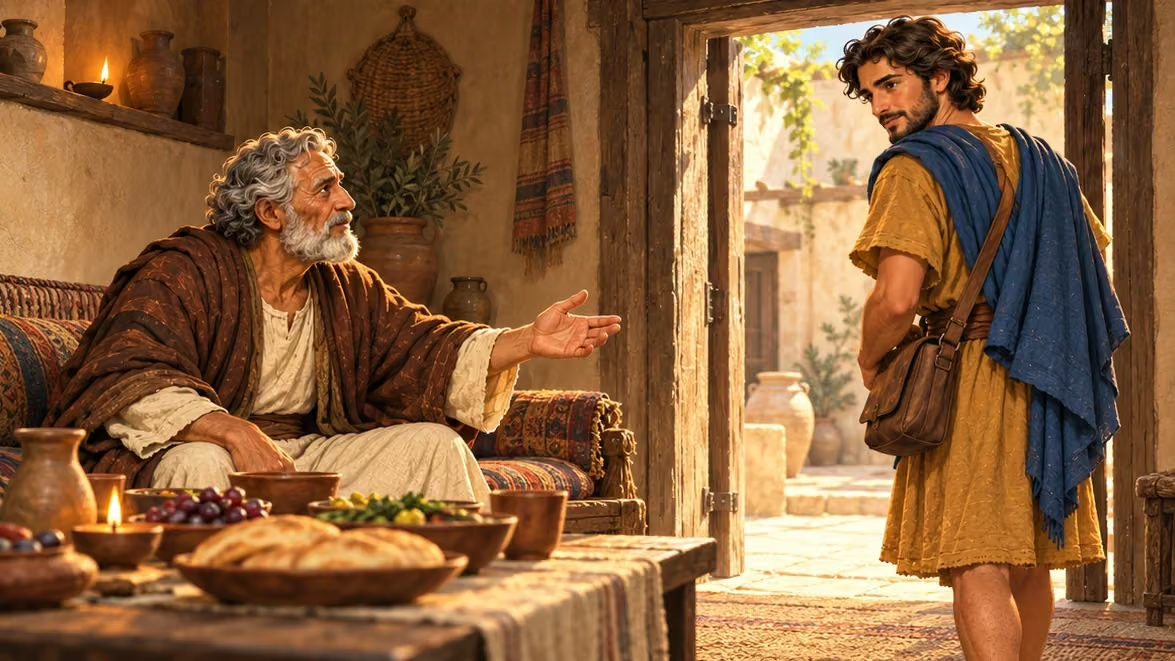
Tobit 2:2
A place for someone in need
Mercy, blindness, and a wounded household · Tobit 2
Open this scene in the reader →2And I saw much food, and I said to my son, “Go and bring whichever one of our brothers you may find in need, who remembers the Lord; and behold, I am waiting for you.”
Step through the story beside the Scripture itself. About the People’s Open Bible