Graphic Bible · Scene 3 of 21
Historical Library · Deuterocanonical Literature
Tobit 4
POB Greek working edition anchored in Swete (1909), retaining its declared local longer-form selection at 6:3–6. Artwork depicts events, reported memories and prayers as this edition presents them.
Source and translation notes
The edition opens with the book of the words of Tobit. The artwork does not authenticate portraits or authorship.
· Greek
Source edition: Available POB working translation anchored in Swete 1909 Greek, with a declared local Sinaiticus-form selection at Tobit 6:3–6 applied 2026-10-04. This is an eclectic working book, not a continuous Sinaiticus edition or a newly established critical text. Pinned revision: 0aa3e29d92329a4f9420c88f0fcf20ba48e76757
Chapter and verse numbers follow the available POB edition, including its supplied gaps. Source records are displayed once in their supplied order; missing numbers are not reconstructed.
- Tobit 4:1[a] Or 'the money'; Greek 'the silver' can refer to coined or weighed money.
- Tobit 4:1[b] 'Rages' is also commonly rendered 'Rhages.'
- Tobit 4:2[a] The parallel Semitic tradition expands this thought: Tobit calls Tobiah in order to inform him about the money deposited with Gabael before he dies.
- Tobit 4:3[a] Or 'do not overlook' or 'do not disregard your mother.' The parallel Semitic tradition has a stronger sense like 'do not abandon her.'
- Tobit 4:4[a] Greek literally, 'she has seen many dangers because of you in the womb,' an idiom referring to the dangers she underwent during pregnancy and childbirth.
- Tobit 4:4[b] Or 'in the same tomb.'
- Tobit 4:5[a] Or 'Practice justice ... do not walk in the ways of injustice.' The Greek terms can carry both personal-moral and social-ethical force.
- Tobit 4:6[a] Or 'all who practice justice.' The Greek δικαιοσύνη can denote righteousness or justice depending on context.
- Tobit 4:6[b] The Greek wording is somewhat compressed; the sense is that truthful, upright conduct leads to success in one's undertakings.
- Tobit 4:7[a] Or 'do not let your eye envy' / 'do not be stingy' when giving; the Greek idiom speaks of a grudging or resentful attitude in almsgiving.
- Tobit 4:7[b] Or 'from any poor person.' The Greek has masculine singular with generic force.
- Tobit 4:7[c] Or 'the presence of God,' though the Greek literally says 'the face of God' and echoes the previous clause's 'your face.'
- Tobit 4:8[a] Or 'According to what you have, in proportion to your abundance, do almsgiving from your possessions.'
- Tobit 4:9[a] Or, 'for the day of need,' 'for a time of distress,' or 'for a day of trouble.' The Greek phrase is broad and can refer to urgent need or hardship.
- Tobit 4:10[a] Or 'charity' or 'acts of mercy'; the Greek specifically refers to giving alms to the needy.
- Tobit 4:10[b] 'The darkness' likely evokes the realm of death or deep gloom; the Greek leaves the image concise and somewhat open.
- Tobit 4:11[a] Or 'a good offering'; the Greek word can denote a gift generally and in some contexts an offering.
- Tobit 4:12[a] Or, 'we are descendants of the prophets.' The Greek reads literally, 'sons of the prophets.'
- Tobit 4:12[b] That is, from among their close kin or clan, not their literal brothers.
- Tobit 4:13[a] Or, 'do not be haughty toward your brothers and the sons and daughters of your people when taking a wife for yourself from among them.' The Greek syntax is compressed, and the relation between the warning against pride and the marriage clause can be understood in more than one way.
- Tobit 4:13[b] 'Idleness' could also be rendered 'sloth' or, less likely in this context, 'worthlessness.' The surrounding lines about decline, want, and famine favor the sense of laziness or unproductive inactivity.
- Tobit 4:15[a] Or, 'And what is hateful to you, do not do to anyone.'
- Tobit 4:16[a] Or, more idiomatically, 'Whatever you have in abundance, give as alms.'
- Tobit 4:16[b] Literally, 'do not let your eye be envious'; that is, do not begrudge giving alms.
- Tobit 4:17[a] Or, 'at the tomb of the righteous.' The phrase may refer to a funerary or memorial act of charity, but the Greek is kept literal here.
- Tobit 4:18[a] Or 'every useful counsel.' The Greek repeats the same counsel/advice word used earlier in the verse.
- Tobit 4:19[a] Or 'all your paths and counsels may succeed.' The Greek βουλαί can mean 'plans,' 'purposes,' or 'counsels.'
- Tobit 4:19[b] The clause 'no nation has counsel' is abrupt in Greek and may mean that no people possesses ultimate counsel in itself, in contrast to the Lord, who gives good things and humbles whomever he wills.
- Tobit 4:20[a] Or 'I am making known to you' for ἐπιδεικνύω; the verb can mean to point out or disclose, not only to display physically.
- Tobit 4:21[a] Or, 'there is much for you.' The Greek expression can denote what one possesses or what is available to one.
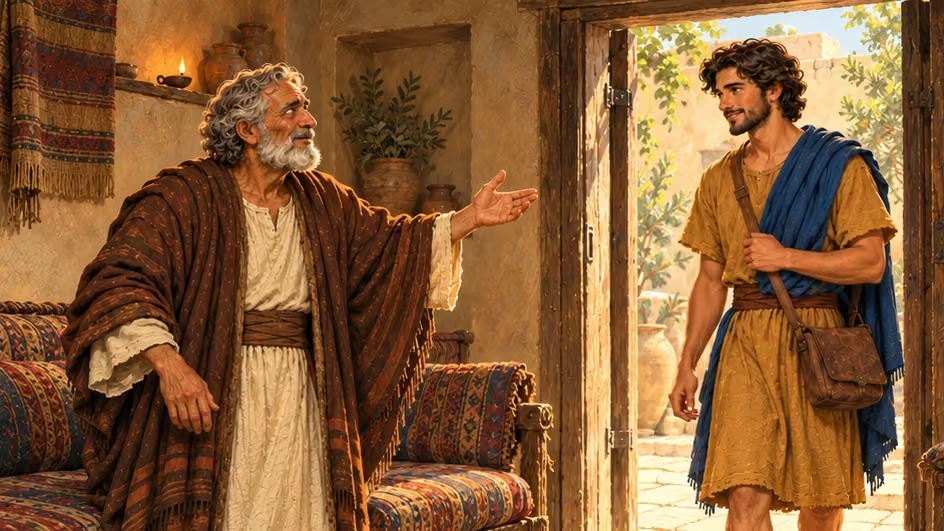
Tobit 4:3
Honor your mother
Counsel before the journey · Tobit 4
Story guide: The living father gives conditional instructions; no burial is enacted here.
Open this scene in the reader →3And calling him, he said, “Child, if I die, bury me, and do not neglect your mother; honor her all the days of your life,”
Step through the story beside the Scripture itself. About the People’s Open Bible