Graphic Bible · Scene 10 of 22
Historical Library · Deuterocanonical Literature
Tobit 5
POB Greek working edition anchored in Swete (1909), retaining its declared local longer-form selection at 6:3–6. Artwork depicts events, reported memories and prayers as this edition presents them.
Source and translation notes
The edition opens with the book of the words of Tobit. The artwork does not authenticate portraits or authorship.
· Greek
Source edition: Available POB working translation anchored in Swete 1909 Greek, with a declared local Sinaiticus-form selection at Tobit 6:3–6 applied 2026-10-04. This is an eclectic working book, not a continuous Sinaiticus edition or a newly established critical text. Pinned revision: 0aa3e29d92329a4f9420c88f0fcf20ba48e76757
Chapter and verse numbers follow the available POB edition, including its supplied gaps. Source records are displayed once in their supplied order; missing numbers are not reconstructed.
- Tobit 5:1[a] The parallel Semitic-form witness reads explicitly, 'Tobiah answered his father ... all that you commanded me, my father, I will do.' The Greek main witness has the simpler 'answered him' and vocative 'Father.'
- Tobit 5:2[a] The Greek says 'the silver'; here it refers to money entrusted for safekeeping, so 'the money' is used for clarity.
- Tobit 5:2[b] The parallel Semitic tradition expands the thought: 'How can I take the money from Gabael? He will not recognize me, and I do not recognize him...,' making explicit that the problem is mutual lack of acquaintance.
- Tobit 5:3[a] Or “the money.” Greek ἀργύριον literally means “silver,” but in context it refers to the deposited funds.
- Tobit 5:3[b] The parallel Semitic witness points to a token or identifying document connected with the deposit; this supports translating χειρόγραφον as a written note rather than a generic letter.
- Tobit 5:4[a] Or 'messenger.' The Greek word can mean either, but here the narrator means that Raphael was an angelic being.
- Tobit 5:5[a] Greek ἐν Ῥάγοις literally reads 'in Rages,' but in this travel context it likely indicates destination, hence 'to Rages.' The Semitic parallel also supports a destination sense.
- Tobit 5:5[b] The place name is often rendered 'Rhages' in English; here it is transliterated 'Rages' directly from the Greek form.
- Tobit 5:6[a] Or, “I am experienced in the road,” that is, “I know the route well.” The Semitic parallel similarly expands the sense to knowing the roads.
- Tobit 5:7[a] The Greek text is brief: 'And Tobiah said to him, “Wait for me, and I will tell my father.”' A parallel Semitic-form witness expands the scene by stating that Tobiah went and informed his father about the man he had found, then went out to call him. The main text follows the Greek source while the fuller context is preserved here.
- Tobit 5:8[a] Greek: 'Go, and do not delay.' The Semitic parallel material for this section is fuller in surrounding verses, but this command itself is straightforward and does not materially alter the translation here.
- Tobit 5:9[a] Or “one who will accompany me.”
- Tobit 5:9[b] “What tribe he is from” reflects the Greek concern for Israelite tribal identity.
- Tobit 5:9[c] Or “whether he is reliable/faithful to go with you.”
- Tobit 5:10[a] The Greek text here is brief: 'And he called him; and he went in; and they greeted one another.' A longer Semitic-form tradition of Tobit preserves fuller dialogue in this part of the story, but the main text follows the extant Greek witness used for this translation.
- Tobit 5:12[a] The Greek is slightly elliptical at the end: literally, 'I want, brother.' The translation supplies 'to know' from the preceding question to make the sense explicit.
- Tobit 5:12[b] The wording 'tribe and family line' reflects social and genealogical identity, not necessarily two sharply distinct categories in modern terms.
- Tobit 5:12[c] The source text for this verse shows a minor mismatch in transcription confidence, but the overall sense is clear.
- Tobit 5:13[a] Or 'from among your kinsmen' / 'of your relatives'; Greek 'of your brothers' can function as a broader kinship term in this context.
- Tobit 5:14[a] Or 'Go in health.' The Greek literally says, 'May you come in health,' a conventional wish for well-being.
- Tobit 5:14[b] 'Our brothers' here refers to fellow kinsmen/Israelites, not necessarily only male siblings.
- Tobit 5:15[a] Or 'what shall I pay you?' The Greek asks directly what compensation Tobit should give.
- Tobit 5:16[a] Literally, 'if you return being healthy.' The Greek emphasizes bodily well-being on the journey.
- Tobit 5:17[a] Or, “may your journey prosper.” The Greek expresses a wish for success on the road.
- Tobit 5:17[b] “Angel” could more generally mean “messenger,” but in Tobit the heavenly sense is most likely.
- Tobit 5:18[a] Or, more interpretively, “our support” for “the staff of our hand.” The main text preserves the metaphor in the Greek.
- Tobit 5:19[a] Greek literally, 'Do not let silver get ahead of silver, but let it become offscouring of our child.' The line is idiomatic: the sense is that money should be treated as worthless compared with the child.
- Tobit 5:21[a] “Sister” is the literal Greek form of address. In this context Tobit is speaking to his wife; the term reflects familial/spousal address rather than biological siblinghood.
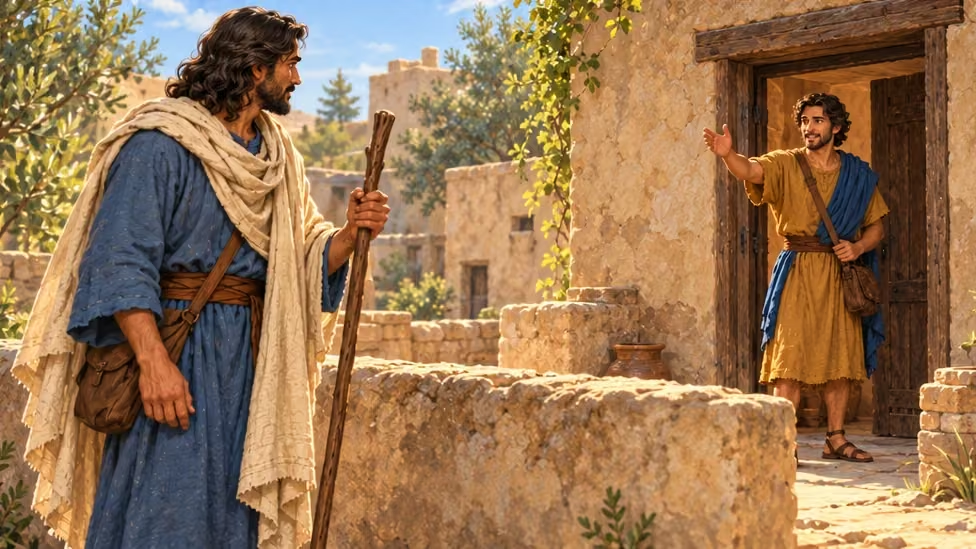
Tobit 5:10
Welcome into the house
A companion for the journey · Tobit 5
Open this scene in the reader →10And he called him, and he went in, and they greeted one another.
Step through the story beside the Scripture itself. About the People’s Open Bible