Graphic Bible · Scene 5 of 18
Historical Library · Deuterocanonical Literature
Tobit 6
POB Greek working edition anchored in Swete (1909), retaining its declared local longer-form selection at 6:3–6. Artwork depicts events, reported memories and prayers as this edition presents them.
Source and translation notes
The edition opens with the book of the words of Tobit. The artwork does not authenticate portraits or authorship.
· Greek
Source edition: Available POB working translation anchored in Swete 1909 Greek, with a declared local Sinaiticus-form selection at Tobit 6:3–6 applied 2026-10-04. This is an eclectic working book, not a continuous Sinaiticus edition or a newly established critical text. Pinned revision: 0aa3e29d92329a4f9420c88f0fcf20ba48e76757
Chapter and verse numbers follow the available POB edition, including its supplied gaps. Source records are displayed once in their supplied order; missing numbers are not reconstructed.
- Tobit 6:1[a] Both Greek forms printed by Swete end Anna’s weeping here and then continue with the journey and fish episode. Different verse divisions in Neubauer’s later Hebrew do not establish that the Greek lacks that narrative.
- Tobit 6:2[a] Both printed Greek forms narrate the journey and the fish encounter. The longer form adds the dog here, but POB already includes the dog in 5:17 following the shorter form. POB selects the longer Greek form locally in 6:3–6; this is not a continuous Sinaiticus edition.
- Tobit 6:3[a] POB provisionally selects the longer Greek form of the connected fish episode (6:3–6), as printed from Sinaiticus by Swete. The shorter Greek says the fish wanted to swallow the young man, without specifying his foot or the fish’s size. Published 4Q197 preserves the Aramaic words for foot/leg and large, but its swallowing verb is only partly preserved. These early details support the local choice; early explanatory expansion remains possible, and earliest wording is unresolved.
- Tobit 6:4[a] The selected longer Greek has both taking hold and gaining a firm grip on the fish, followed by bringing it onto land. The shorter Greek has a briefer command and a verb rendered threw it up onto land in the previous POB draft. This follows the declared local form choice, not a newly recovered Aramaic command.
- Tobit 6:5[a] Or bile. The Greek does not explicitly specify a gallbladder.
- Tobit 6:5[b] The longer Greek explicitly directs discarding the guts and identifies the retained organs as medicinally useful. The shorter Greek tells him to keep the organs safely. Not every word of this longer instruction survives in the Aramaic fragments.
- Tobit 6:6[a] In the selected longer Greek, the young man alone roasts and eats some of the fish; he sets aside a salted portion. The shorter Greek says they roasted and ate. Published 4Q197 preserves the complete singular Aramaic eating verb; 4Q196 preserves only its final letter and a following word boundary, conditionally supporting the singular reconstruction. This does not prove original wording or settle the angel’s nature.
- Tobit 6:6[b] The longer Greek names Media, the region; the shorter Greek names Ecbatana, a city. The selected wording expresses approach, not full arrival.
- Tobit 6:7[a] Or 'the bile of the fish.' The Greek χολή can be rendered 'gall' or 'bile.'
- Tobit 6:8[a] Or, “burn them” — the Greek verb refers to causing these organs to smoke by burning them.
- Tobit 6:10[a] Greek Ῥάγῃ refers to the city Rages (also spelled Rhages in some English traditions).
- Tobit 6:12[a] Or, 'her inheritance belongs to you' or 'the right to her inheritance devolves upon you.' The Greek expresses a legal claim or obligation tied to kinship.
- Tobit 6:12[b] Or, 'you alone are of her kin.'
- Tobit 6:13[a] Or, more literally, 'according to the law of Moses'; in context the sense is that giving her to another man would violate that law and make Raguel liable to death.
- Tobit 6:13[b] Greek literally, 'because it is fitting for you to receive the inheritance than every man,' an idiomatic way of saying that you have the prior claim over any other man.
- Tobit 6:14[a] Or “to seven husbands.” The Greek says “to seven men,” but the marriage context may justify the more specific sense.
- Tobit 6:14[b] Literally “all of them in the bridal chamber were prevented/kept away.” In context, this refers to the previous bridegrooms being unable to complete the marriage because they died there.
- Tobit 6:15[a] Or 'those before me'; the phrase refers to Sarah's previous husbands or suitors.
- Tobit 6:15[b] The Greek says 'a demon loves her,' expressing the demon's possessive attachment to Sarah.
- Tobit 6:15[c] Literally 'bring down the life of my father and my mother ... to their grave'—an idiom for causing them to die in grief because of me.
- Tobit 6:16[a] Or, 'give no thought to the demon.' The Greek idiom literally says, 'have no word/account of the demon.'
- Tobit 6:17[a] Or 'ashes of incense.' The Greek phrase may be rendered more literally this way.
- Tobit 6:17[b] That is, produce smoke from the ashes with some of the fish’s heart and liver on them; the verb is more specific than simply 'burn.'
- Tobit 6:18[a] Or, 'it will not return for ever and ever.' The Greek expression is an emphatic idiom for permanent non-return.
- Tobit 6:18[b] 'Go in to her' is a marital idiom here, referring to approaching Sarah as husband to wife.
- Tobit 6:18[c] Or, 'from of old' or 'from long ago.' The Greek can denote remote antiquity as well as an eternal horizon.
- Tobit 6:18[d] 'His soul was bound to her' is a vivid idiom for deep attachment, not merely momentary affection.
Tobit 6:5
Keep what is useful
The fish and the promised marriage · Tobit 6
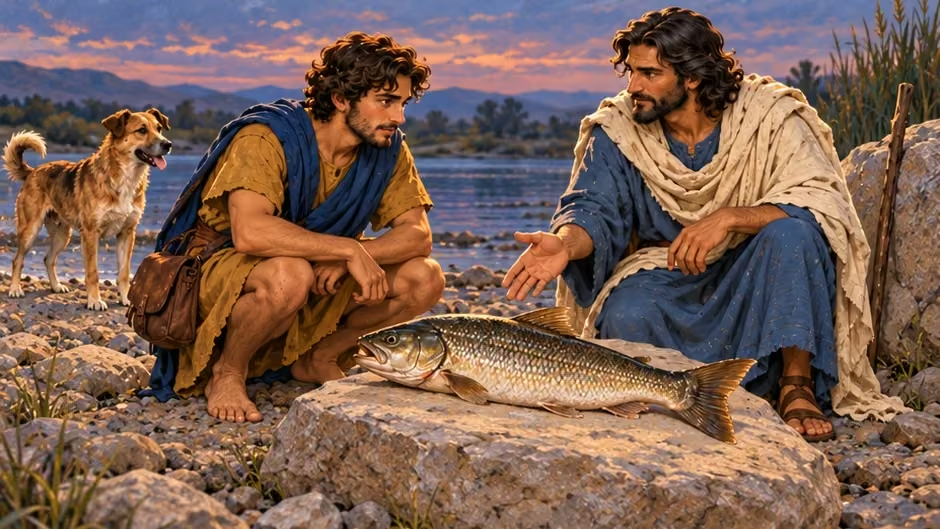
Open this scene in the reader →5The angel said to him, “Cut open the fish, remove its gall, heart and liver, and keep them with you. Throw away the guts, because its gall, heart and liver are useful as medicine.”
Step through the story beside the Scripture itself. About the People’s Open Bible