Graphic Bible · Scene 18 of 18
Historical Library · Deuterocanonical Literature
Tobit 7
POB Greek working edition anchored in Swete (1909), retaining its declared local longer-form selection at 6:3–6. Artwork depicts events, reported memories and prayers as this edition presents them.
Source and translation notes
The edition opens with the book of the words of Tobit. The artwork does not authenticate portraits or authorship.
· Greek
Source edition: Available POB working translation anchored in Swete 1909 Greek, with a declared local Sinaiticus-form selection at Tobit 6:3–6 applied 2026-10-04. This is an eclectic working book, not a continuous Sinaiticus edition or a newly established critical text. Pinned revision: 0aa3e29d92329a4f9420c88f0fcf20ba48e76757
Chapter and verse numbers follow the available POB edition, including its supplied gaps. Source records are displayed once in their supplied order; missing numbers are not reconstructed.
- Tobit 7:1[a] Greek: 'Sarah also met him.' The final clause has an implicit singular subject ('he brought them into the house'); the text does not explicitly name who brought them in.
- Tobit 7:1[b] The parallel Semitic witness reflects the same arrival-and-greeting scene at Raguel's house, though with some differences in wording and detail.
- Tobit 7:2[a] The Greek text reads, 'Edna said to his wife,' though the Semitic parallel has Raguel speaking to Edna his wife. The context may suggest a textual or transmission irregularity.
- Tobit 7:2[b] Or 'my cousin.' The Greek kinship term can be used more broadly for a close male relative, though 'nephew' is the more specific sense.
- Tobit 7:3[a] Or “from the descendants of Naphtali” or “from the tribe of Naphtali.” The Greek literally says “from the sons of Naphtali.”
- Tobit 7:3[b] Or “the exiles in Nineveh.” The Greek says “the captives,” emphasizing their deported status.
- Tobit 7:4[a] Or 'our kinsman' / 'our relative.' The Greek says 'our brother,' likely as a kinship term rather than for a literal sibling.
- Tobit 7:5[a] Greek: 'lives and is healthy'; rendered idiomatically as 'is alive and well.'
- Tobit 7:5[b] Traditional English forms often use 'Tobias' here instead of 'Tobiah.'
- Tobit 7:6[a] The Greek verb behind 'kissed him warmly' is stronger than a simple 'kissed' and suggests marked affection.
- Tobit 7:6[b] The parallel Semitic reference supplied here is a much later back-translation and does not control the wording of this verse; the translation is anchored in the Greek witness.
- Tobit 7:7[a] Greek is elliptical here; literally, 'the one of the noble and good man.' The translation supplies 'son' for clear English and likely sense in context.
- Tobit 7:7[b] Or, 'had lost his sight.' The Greek says more literally, 'had lost his eyes.'
- Tobit 7:8[a] Or 'received them warmly' or 'received them willingly'; the Greek adverb emphasizes ready, wholehearted hospitality.
- Tobit 7:11[a] Greek 'seven men'; the context indicates these were the men to whom she had been given in marriage, so 'seven husbands' is a possible contextual rendering.
- Tobit 7:11[b] The final clause is difficult in the Greek witness here. The translation reflects the apparent sense: Tobiah refuses to eat until the marriage arrangement is formally settled with him.
- Tobit 7:12[a] 'Brother' here reflects kinship language and likely means a close relative eligible under family custom, not a literal sibling.
- Tobit 7:12[b] Or 'according to the ruling' or 'according to the legal decision.'
- Tobit 7:12[c] The Greek could also be rendered more literally, 'the merciful God will prosper for you the best things.'
- Tobit 7:13[a] Or “receive her” for “take her”; the Greek imperative can carry the sense of taking, receiving, or bringing, but the following command already expresses the movement toward his father.
- Tobit 7:14[a] Or 'a written agreement' or simply 'a contract'; the Greek term refers to a formal written legal document. 'Marriage contract' is chosen because the immediate context is the marriage arrangement.
- Tobit 7:15[a] “Sister” is a literal kinship form of address to his wife, preserving the Greek wording; it functions idiomatically as an affectionate domestic address.
- Tobit 7:15[b] Or “the other chamber.” The Greek ταμεῖον can refer to an inner room or chamber.
- Tobit 7:16[a] Greek: 'the tears of her daughter.' The context strongly suggests the sense is 'his daughter,' referring to Ragouel and Sarah.
- Tobit 7:17[a] Or 'grace' instead of 'favor'; the Greek χάρις can bear either sense here.
- Tobit 7:18[a] Or “the other chamber.” The Greek ταμεῖον can refer to an inner room or chamber.
- Tobit 7:18[b] “Sister” is a literal form of address to his wife, not a statement of biological relationship.
Tobit 7:18
The chamber is requested again
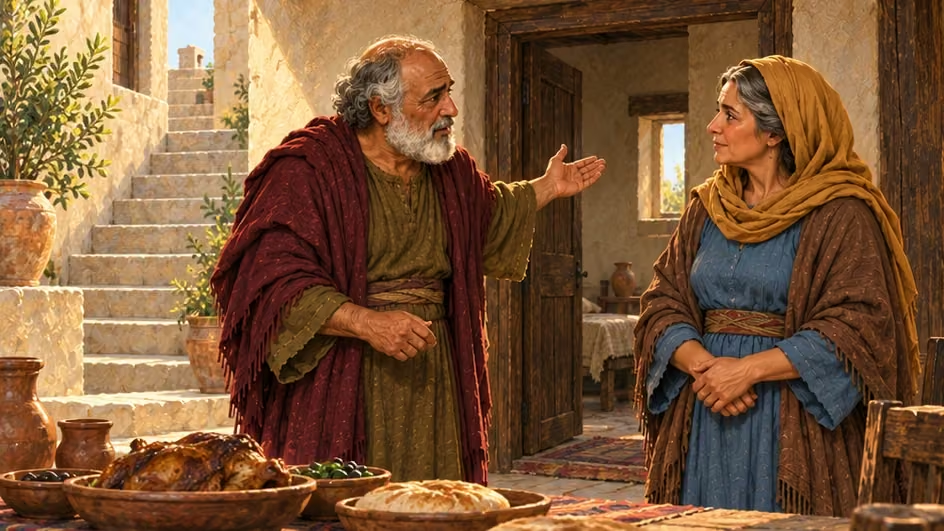
A household receives the travelers · Tobit 7
Story guide: The supplied chapter repeats the chamber instruction here; this scene retains that repetition.
Open this scene in the reader →18And Raguel called Edna his wife and said to her, “Sister, prepare the other chamber and bring her in there.”
Step through the story beside the Scripture itself. About the People’s Open Bible