Graphic Bible · Scene 6 of 13
Historical Library · Deuterocanonical Literature
Tobit 10
POB Greek working edition anchored in Swete (1909), retaining its declared local longer-form selection at 6:3–6. Artwork depicts events, reported memories and prayers as this edition presents them.
Source and translation notes
The edition opens with the book of the words of Tobit. The artwork does not authenticate portraits or authorship.
· Greek
Source edition: Available POB working translation anchored in Swete 1909 Greek, with a declared local Sinaiticus-form selection at Tobit 6:3–6 applied 2026-10-04. This is an eclectic working book, not a continuous Sinaiticus edition or a newly established critical text. Pinned revision: 0aa3e29d92329a4f9420c88f0fcf20ba48e76757
Chapter and verse numbers follow the available POB edition, including its supplied gaps. Source records are displayed once in their supplied order; missing numbers are not reconstructed.
- Tobit 10:1[a] Or, 'they were not coming.' The Greek imperfect can denote that they had still not arrived after the expected time for the journey had passed; in context this implies not returning home on schedule.
- Tobit 10:1[b] The Semitic parallel tradition expands the scene by mentioning counting both days and nights and the parents' distress, but the main translation here follows the shorter Greek wording of the primary source.
- Tobit 10:2[a] Greek literally, “has been put to shame.” The phrase may imply some humiliating setback or failed attempt, but the exact circumstance is not stated.
- Tobit 10:4[a] Greek repeats 'him' ('for him, him'), likely for emphasis or as a scribal repetition; the English smooths this to idiomatic 'for him.'
- Tobit 10:5[a] Or, 'Does it not matter to me, child, that I have sent you away, the light of my eyes?' The Greek wording is a rhetorical question expressing deep personal distress.
- Tobit 10:6[a] Greek literally, 'Do not have a word/matter.' The phrase is rendered idiomatically as 'do not worry.'
- Tobit 10:7[a] Or 'My child is lost.' The Greek ἀπώλετο can express either loss or presumed death; here it reflects the mother's fearful conclusion, not the narrator's confirmation.
- Tobit 10:7[b] Literally 'the fourteen days of the marriage.' The phrase refers to the wedding celebration period.
- Tobit 10:8[a] Or, 'no longer hope to see me.' The Greek verb can denote either expectation or hope; 'expect' was chosen for natural English in context.
- Tobit 10:9[a] Greek literally, 'they will make known to him the things concerning you.' The plural 'they will report' likely refers indefinitely to those sent with the message.
- Tobit 10:10[a] Greek has the historical present, literally 'Tobias says'; English idiom renders it as past tense in narrative.
- Tobit 10:11[a] Or 'slaves' for 'servants'; the Greek literally says 'bodies' in a list of property.
- Tobit 10:11[b] Or 'The God of heaven will prosper you'; the Greek uses a future form that can function as a blessing.
- Tobit 10:12[a] Or 'I place my daughter in your trust'; the Greek says literally, 'I entrust my daughter to you as a deposit.'
- Tobit 10:12[b] 'Restore you' may also carry the sense 'bring you back safely' in this travel context.
- Tobit 10:13[a] Greek: 'because he prospered his way,' an idiom meaning that God granted success to his journey.
- Tobit 10:13[b] The Greek text here is syntactically awkward, with a plural verb ('they came near') alongside a singular pronoun ('him'). The translation gives the apparent narrative sense: the travelers came near to Nineveh.
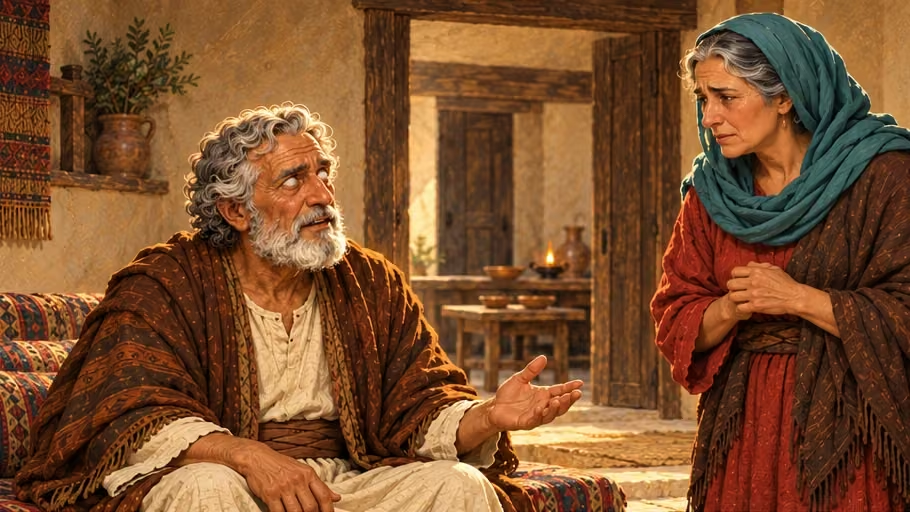
Tobit 10:6
Tobit offers reassurance
Waiting parents and a reluctant farewell · Tobit 10
Open this scene in the reader →6And Tobit said to her, “Be quiet; do not be anxious. Be well.”
Step through the story beside the Scripture itself. About the People’s Open Bible