Graphic Bible · Scene 22 of 22
Historical Library · Deuterocanonical Literature
Tobit 12
POB Greek working edition anchored in Swete (1909), retaining its declared local longer-form selection at 6:3–6. Artwork depicts events, reported memories and prayers as this edition presents them.
Source and translation notes
The edition opens with the book of the words of Tobit. The artwork does not authenticate portraits or authorship.
· Greek
Source edition: Available POB working translation anchored in Swete 1909 Greek, with a declared local Sinaiticus-form selection at Tobit 6:3–6 applied 2026-10-04. This is an eclectic working book, not a continuous Sinaiticus edition or a newly established critical text. Pinned revision: 0aa3e29d92329a4f9420c88f0fcf20ba48e76757
Chapter and verse numbers follow the available POB edition, including its supplied gaps. Source records are displayed once in their supplied order; missing numbers are not reconstructed.
- Tobit 12:1[a] Greek: 'child'; the parallel Semitic phrasing reads 'my son.' The main text follows the Greek vocative while preserving the familial nuance in context.
- Tobit 12:2[a] The Greek says literally, 'I am not harmed, having given him half of what I have brought.' The sense is that paying the guide half the recovered goods would not leave Tobias at a loss.
- Tobit 12:2[b] The Semitic parallel likewise supports the sense of taking half of the money/goods brought back, reinforcing 'brought back' rather than a bare 'brought.'
- Tobit 12:5[a] The Greek source excerpt provided for this verse is incomplete and ends mid-sentence after 'of everything that'. The translation therefore preserves the unfinished clause rather than supplying words not present in Zone 1.
- Tobit 12:6[a] Greek literally, 'give him greatness'; the sense is to ascribe greatness or honor to God.
- Tobit 12:6[b] Greek literally, 'for what he has done with you'; this may also be understood as 'for what he has done for you.'
- Tobit 12:6[c] The Greek witness provided is incomplete at the end of the verse, ending with 'and do not ...'; the prohibition continues in the following verse.
- Tobit 12:7[a] Or 'confess to him,' 'give thanks to him,' or 'praise him openly.' The Greek verb can carry any of these public-acknowledgment senses depending on context.
- Tobit 12:7[b] Or 'honorably' / 'with due honor.' The Greek adverb may describe the fitting manner of speaking about God's works.
- Tobit 12:8[a] Or 'justice' ... 'injustice' for 'righteousness' ... 'unrighteousness.'
- Tobit 12:8[b] The final clause is literally 'to do almsgiving rather than to store up gold'; English could also be rendered more idiomatically, 'to give alms rather than to store up gold.'
- Tobit 12:9[a] Or 'Those who practice almsgiving and righteous deeds will have their fill of life.'
- Tobit 12:10[a] Or 'enemies of their own soul.' The Greek word can be rendered more broadly, but 'life' is the plainer sense here.
- Tobit 12:11[a] Or 'the mystery of a king.' Here the Greek word refers to a confidential matter or secret, not necessarily a theological 'mystery.'
- Tobit 12:11[b] Or 'honorably' or 'with honor.' The adverb may describe the fitting manner of making God's works known.
- Tobit 12:12[a] Or 'your wife Sarah'; Greek νύμφη can mean 'bride' or 'young wife.'
- Tobit 12:12[b] Or 'the remembrance of your prayer,' possibly with a cultic sense like a memorial offering brought before God.
- Tobit 12:12[c] 'The Holy One' here refers to God in context.
- Tobit 12:13[a] Or 'prepare the dead man for burial.' The Greek verb can refer to wrapping or otherwise arranging a corpse.
- Tobit 12:13[b] The Greek for 'your meal' uses a term that can denote a principal meal; the exact time of day is not specified here.
- Tobit 12:14[a] Or 'your daughter-in-law Sarah.' The Greek νύμφη can mean either 'bride/young wife' or 'daughter-in-law,' and the addressee here is Tobit.
- Tobit 12:15[a] Or 'the saints.' The Greek phrase means 'the holy ones.'
- Tobit 12:17[a] Or, 'peace will be with you.' The Greek literally reads, 'peace to you will be.'
- Tobit 12:18[a] Or 'not by my own grace.' The Greek χάρις can mean 'grace' or 'favor'; here it likely refers to Raphael's own initiative or beneficence.
- Tobit 12:19[a] Or 'I appeared to you ... but what you were observing was a vision.' The Greek imperfects can be rendered either with ongoing force ('was appearing,' 'were seeing') or more simply in English as past events.
- Tobit 12:20[a] Or 'confess to God' or 'praise God'; the Greek verb can cover acknowledgment expressed in thanksgiving or praise.
- Tobit 12:21[a] Or, 'they could no longer see him.' The Greek more literally says, 'they did not see him,' which may imply his disappearance without stating it directly.
- Tobit 12:22[a] Or, 'they gave thanks for / openly acknowledged his great and wondrous works.' The Greek verb can carry senses of confession, acknowledgment, thanksgiving, or praise depending on context.
- Tobit 12:22[b] Greek: 'an angel of the Lord'; some English traditions may expect 'the angel of the Lord,' but the Greek here does not require the definite sense.
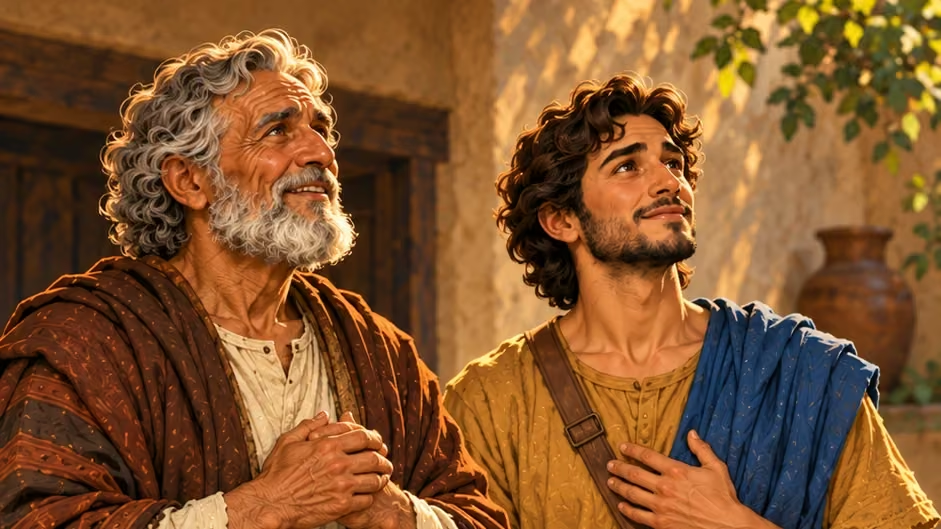
Tobit 12:22
Acknowledging the wondrous works
The companion reveals his name · Tobit 12
Story guide: The men acknowledge the great and wondrous works after the revelation. An angel of the Lord is preserved in the attached source text.
Open this scene in the reader →22And they acknowledged his great and wondrous works, because an angel of the Lord had appeared to them.
Step through the story beside the Scripture itself. About the People’s Open Bible